
The former customer’s report suggesting leasing firms played a role in the scandal has lawyers, investigators paying attention
Wednesday, April 27, 2005
BY GREG SAITZ
Star-Ledger Staff
Dada artist Marcel Duchamp is known for taking what he said were everyday objects — a urinal, for example — and declaring them “art.”
Failed Newark telecommunications company Norvergence is known for allegedly defrauding 11,000 small businesses and leaving many of them stuck paying overvalued leases.
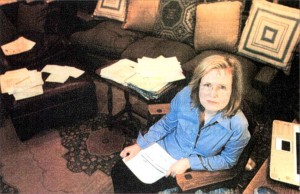
Rhonda Roland Shearer is hard at work trying to unlock the secrets of both.
Shearer is an artist, researcher and the widow of Harvard paleontologist Stephen Jay Gould. She also is a former customer of Norvergence, who like thousands of others lost phone and Internet service last summer when the telecommunications business was forced into bankruptcy court and out of business.
Norvergence, which had its offices at 550 Broad St., has been accused of fraud by federal and state authorities. Investigations are being conducted into not only the company itself, but also the leasing firms that purchased customer leases from Norvergence.
Meanwhile, the courts are clogged with lawsuits from leasing companies trying to collect on contracts and cases against the financing firms alleging violations of consumer protection laws. Many businesses continue to make required monthly lease payments for useless equipment.
Enter Shearer, 50, a petite woman with an intense focus who initially wasn’t going to pursue the case. She called an attorney at CIT Group, the company that held her $22,600 equipment lease, and told him she hoped the firm would walk away as opposed to trying to collect from Norvergence customers who no longer received phone service.
“I basically said, rhetorically, ‘Don’t make me get involved in this. I do investigations,'” Shearer said last week at her 4,000-square-foot loft in Soho in Lower Manhattan, which acts as her home and a base for her nonprofit Art Science Research Laboratory.
In the end, she did. Shearer spent a couple of months reviewing documents, conducting interviews and delving into the general practices of the leasing industry. She hired an appraiser to officially value the Matrix box Norvergence claimed was the key to big cost savings for customers.Government officials have estimated the maximum value of the Matrix box at about $1,500, although some leases ran as much as $340,000 for the equipment.
In March, she published a lengthy report suggesting the leasing companies played a significant role in the Norvergence scandal and may have crossed the line into fraud on several fronts.
CIT, which has said it will take $15 million in charges because of the Norvergence case, declined to comment on Shearer’s report.
She said her research has been widely circulating among attorneys general, Federal Trade Commission attorneys, federal prosecutors and other lawyers involved in Norvergence-related lawsuits. She continues to investigate, and in her library, whose walls are lined with books such as “Likeness and Presence: A History of the Image Before the Era of Art,” piles of Norvergence and leasing documents are spread on tables and an ottoman.
Milltown attorney Michael Green, who is pursuing a class- action case on behalf of Norvergence customers against the leasing companies, described Shearer as “a force of nature.”
“She just doesn’t stop, and she won’t stop,” he said. “I think CIT made a big mistake making her one of their enemies.
“She’s got a way about her, and because she’s so persistent, she’s gotten some people to talk when others can’t,” he said.
Michael Fleming would agree Shearer has a way about her. But to the president of the Equipment Leasing Association trade group, that isn’t a good thing.
“A lot of her observations and conclusions are quite wide, but about an inch thick,” Fleming said. “She’s just mistaken, and there’s no reason anybody should assume this person is an expert in this.”
Says Shearer, “People don’t like to hear things that expose them for being factually wrong or, in the case of the leasing companies, interrupts their argument they’ve been giving to attorney generals, which is persuasive but wrong.”
The leasing issue is hardly the first time Shearer has caused a stir. Three years ago, she challenged many details in William Langewiesche’s nonfiction book on the cleanup of Ground Zero.
And in 1997, the Duchamp scholar published a paper proposing many of the French artist’s “readymades” or found objects were actually of his own making.
For now though, Shearer is focused on Norvergence and the leasing industry. She has started, along with attorneys and other former Norvergence customers, the Lessee Rights Association. The group is planning protests at an Equipment Leasing Association meeting in Miami next month and outside the Monmouth County Courthouse in June, when a Norvergence hearing is scheduled.
Additionally, she plans on traveling to Washington to lobby the Senate Finance Committee to hold hearings on the leasing industry.
“Since I have the abilities to do this kind of research and understand how to mobilize resources, I feel obligated and dutybound when something like this comes in front of me, to act,” Shearer said. “There’s so many things that are wrong in the world you can do nothing about. But this is one where I believe that something can be done.”
